Summary of our CanLII Webinar

If you have missed the last training session on CanLII or just want to have another look, here is a summary of what was said.

About CanLII 

CanLII stands for Canadian Legal Information Institute. It is a non-profit organization that started in 2001.  

  • It was funded in a joint effort by the Federation of Law Societies. 
  • In general, it is part of a larger free access to the law movement. This website is available to anyone with internet access, with no cost to the user at any point. 

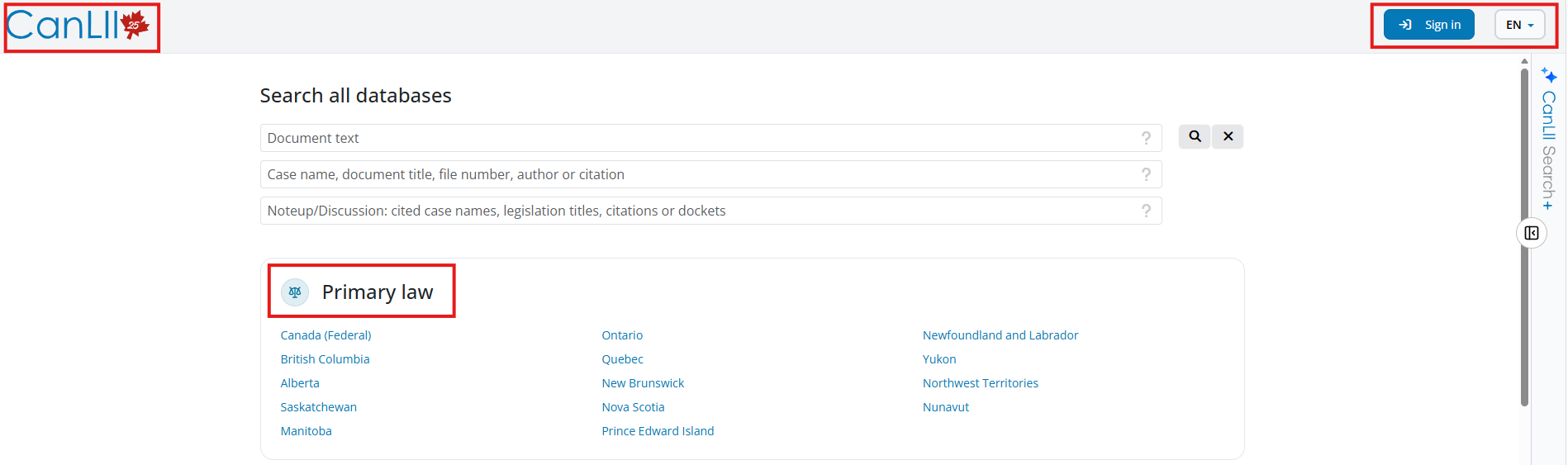
In the top right corner, there is a drop-down box if you wish to change the language of the website, their interface is bilingual, but it will not change the language of the case or the legislation you are looking at. To do that you will have to change the language from the document you are viewing. It is a separate function because not all content is available in both languages. You also have the sign in button. You do not need an account to use CanLII. It is only if you wish to use their other functionalities, such as myCanLII and the CanLII AI tool. On the other side, the CanLII logo will bring you back to the homepage when you click on it.  


Primary law 

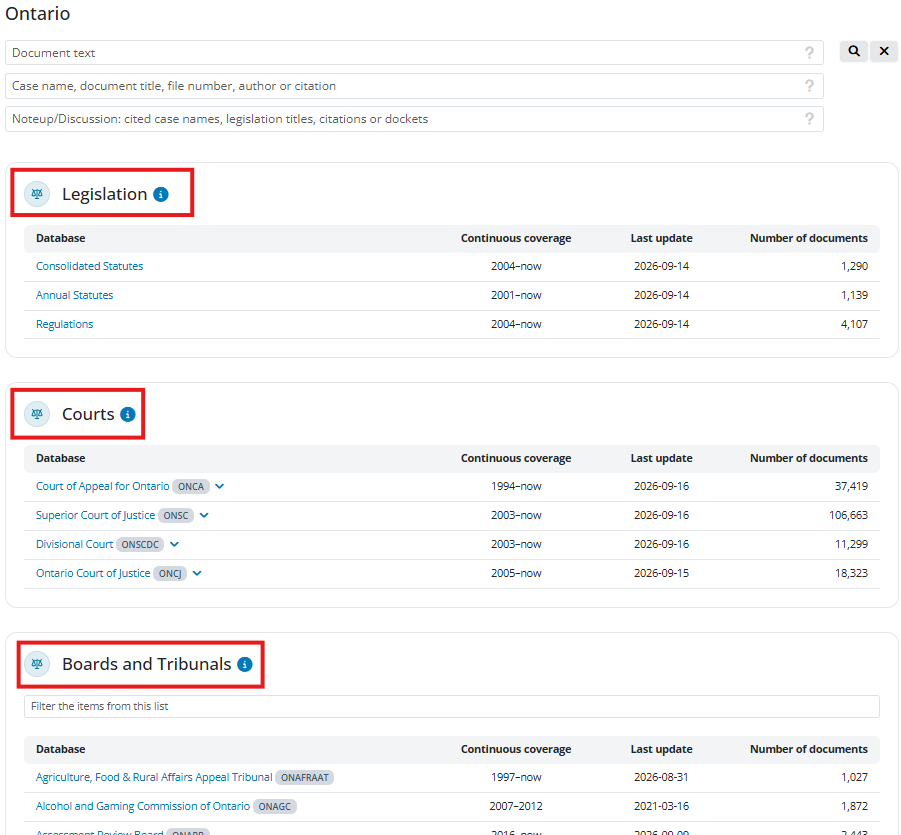
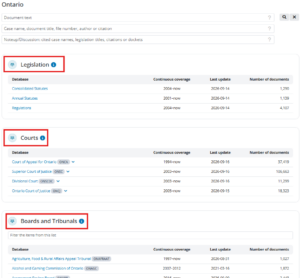
Under the search section, we have Primary law.  This section contains legislation and decisions from all over Canada. Here is the page for Ontario:
Ontario Primary Law

You can then use the search box at the top, and it will search things from Ontario only or you can browse through the list of databases. From here, you have access to legislation and Courts, Boards and Tribunals decisions from Ontario. The Federal page looks very similar.


Commentary 

Commentary refers to the secondary resources that CanLII has, meaning materials about the primary materials. That collection contains a few different types of commentary materials, so to get to the commentary, you can click on See all and then you can choose which type of document you want to browse, books, articles, reports, etc. It will then show you a list of the different publications or where the material is from. 

CanLII commentary section

I want to highlight three items under books. They can all be found under CanLII (Canadian Legal Information Institute). 

  • The Criminal Law Ebook – Canadian Legal Information Institute 


Searching

You have three options to begin your research. If you use the boxes from the main page, you are by default searching everything on CanLII – all federal and provincial legislation, cases, decisions, commentary, etc. I will start with the last two boxes, and finish with the first one. 

CanLII Search boxes

Document text 

The first one, “Document text”, is your keyword search. It is in this box that you will use your Boolean terms and keywords.  

For example, you can use this box when you do not know exactly the case you are looking for, you have larger question or you are looking for something on a specific topic. This box will not predict what you are typing. 
CanLII Search

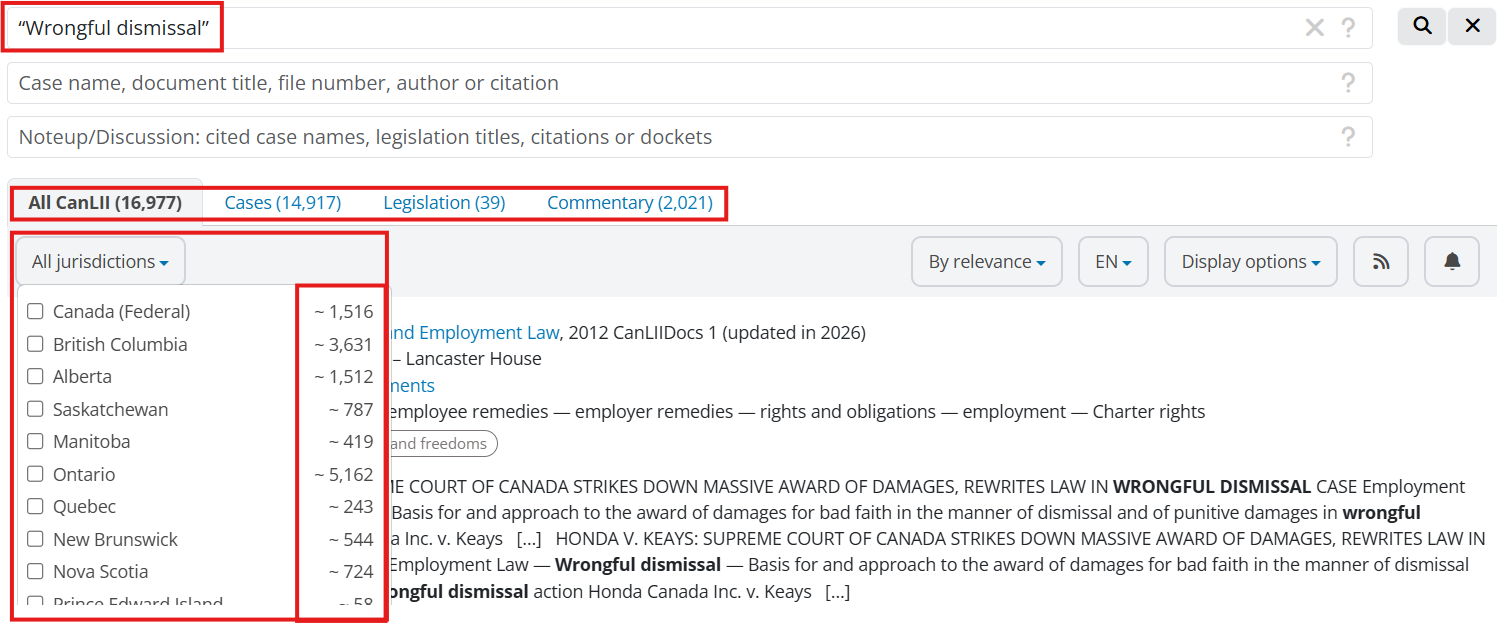
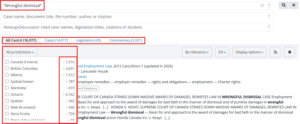
The first tab says “All CanLII”. This means you have over 16000 results from the entire scope of CanLII. As you look along the rows, you can see where those are (cases, legislation and commentary). 

That first tab for all of CanLII – you can do an immediate sort right here by jurisdiction. Next to each jurisdiction is a number – that is how many results per jurisdiction.  

If you are doing this search to find case law, you want to move over to the next tab, which is the cases tabThere are four options, which you can see just below the tab – jurisdictions, court and tribunals, date, and subjects. 

For the first, jurisdiction. It is the same as the one we just saw. When you select a province, you will get the line at the top. It says “there are X decisions from the Supreme Court of Canada that match the search” – add them to your results. This means the results in general are just from the province you selected, which is what you want, but you might be missing some key upper court decisions. It will only ask for the Supreme Court, as it is the highest court. 

If you want to do some custom court level searching, this is where you use the next set of filters. If you click on the down arrow next to All Courts and Tribunals, you will be able to select precisely which courts you want to see results from. The default is all courts and all tribunals. You can then start some slightly more specific filters – just courts, just appeal courts, just boards and tribunals, or just boards and tribunals that they have grouped into topical areas – so for example boards and tribunals dealing with labour, or privacy. 

If you want to get even more specific, once you put your cursor into the box at the bottom, a list appears that gives you specific options. The numbers you see indicate how many of those decisions are from that specific court. 

Next filter is date. The default, of course, is any date. You can make this more specific – with the preset options, last week, last three months, last year, last three years, last ten years, and then you can get into some specific date is and date range. As always, you can see how many documents specifically relate to a certain date. 

The last filter is Subjects. These classifications are available as a filter, and are also displayed in the search results list (as bubbles). Note though that these are for court decisions only, not tribunals. 

That is how you can take a keyword search that looks through all the documents on CanLII and narrow it down to specific results.  

Now if you were looking for legislation in your results, you would use the next tab over – legislation. First up, there is a similar jurisdiction filter, which will let you select the province, territory, or federal. 

CanLII legis

The second filter is the type of legislation, it will let you pick constitutional acts, statutes or regulations. You may see some options here that are not available for the jurisdiction you are working in. For example, historical revised statutes are not available for Ontario.  

The final filter is a version or date filter. CanLII does offer point-in-time versions of legislation – early 2000s is about as far back as you can go. You can enter a date there and they will bring you to the legislation available on that date. 

Under the last tab, commentary, you will see there are four ways to narrow. The first is subjectsThe second is type. The third is publication year. 

CanLII comms

The fourth is sources. This gives you three options for some of the commentary on CanLII – titles from the CanLII authors program, the CanLII connects blogs, and “other sources” which are the non-CanLII authors in the commentary collection. Again, you can combine the filters, but you might find your results dropping rapidly. You can always modify your search from the same page, using the search boxes at the top.

A couple other things to note about the results screen. First off, where it says “By Relevance.” If you click on the down arrow, you can change the order in which your results are appearing. The default is by relevance, but you can change that to other options, such as date, most cited, most pages or court level. 

Next, you have the language option. If you want only French results, you can change it and it will show you only the documents available in French. You can note that it is less than in English, because not all of them have a translation. 

You then have the display options. There are two main options, the list and the list with a view of the document. The other options below are if you want less information under your results. Like if you do not want the summary. 


Case name, document title, file number, author or citation 

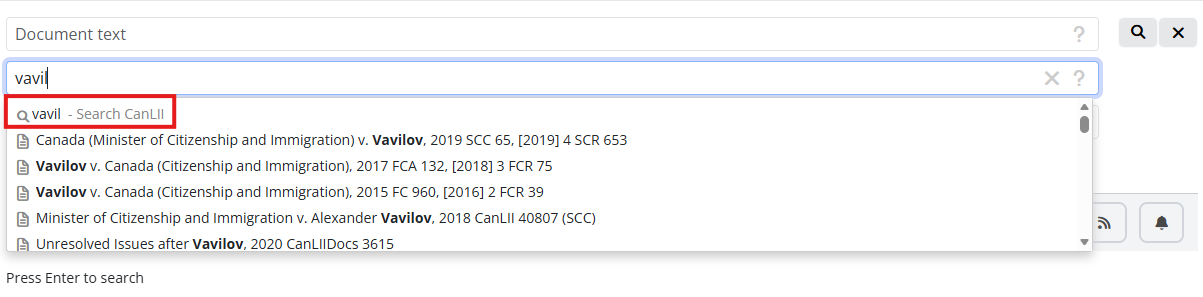
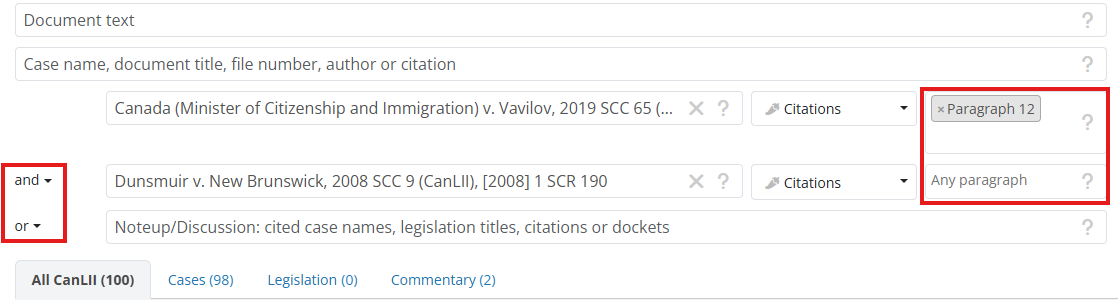
The second box is to find a specific document. For example, if you are looking for Canada v. Vavilov, you start writing and it will give you a list of related documents that you can scroll. You can then click on the document you were looking for, and it will bring you directly to it. CanLII uses a predictive text to suggest results.  

If you do not see it in the list, you can start typing and press enter or select the first line. It will then give you a normal list of results.  

You can also use that section to find other types of documents, such as legislation. And you will be taken directly to that piece of legislation, the most current version of the title you selected.  

CanLII documents

Noteup/Discussion 

The last box is the Noteup/Discussion box. It will allow you to see the documents that cite a specific case, piece of legislation or other type of document. You can also add specific paragraphs to your search. Same thing if you are looking into a certain Act, you can add one or more sections. That way, you can do a very custom search.  

One thing to point out is the “Or” section to the left. The default is set to “Or”. It lets you set up a search that searches for something citing Document A or Document B. It does not have to cite both, just either one.  You can change that to “And”. You can add more documents than that, but this is a cool feature if you are trying to narrow down a lot of citing cases to something on a very specific point.  

CanLII Noteup

Documents

CanLii doc

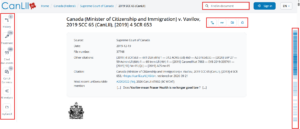
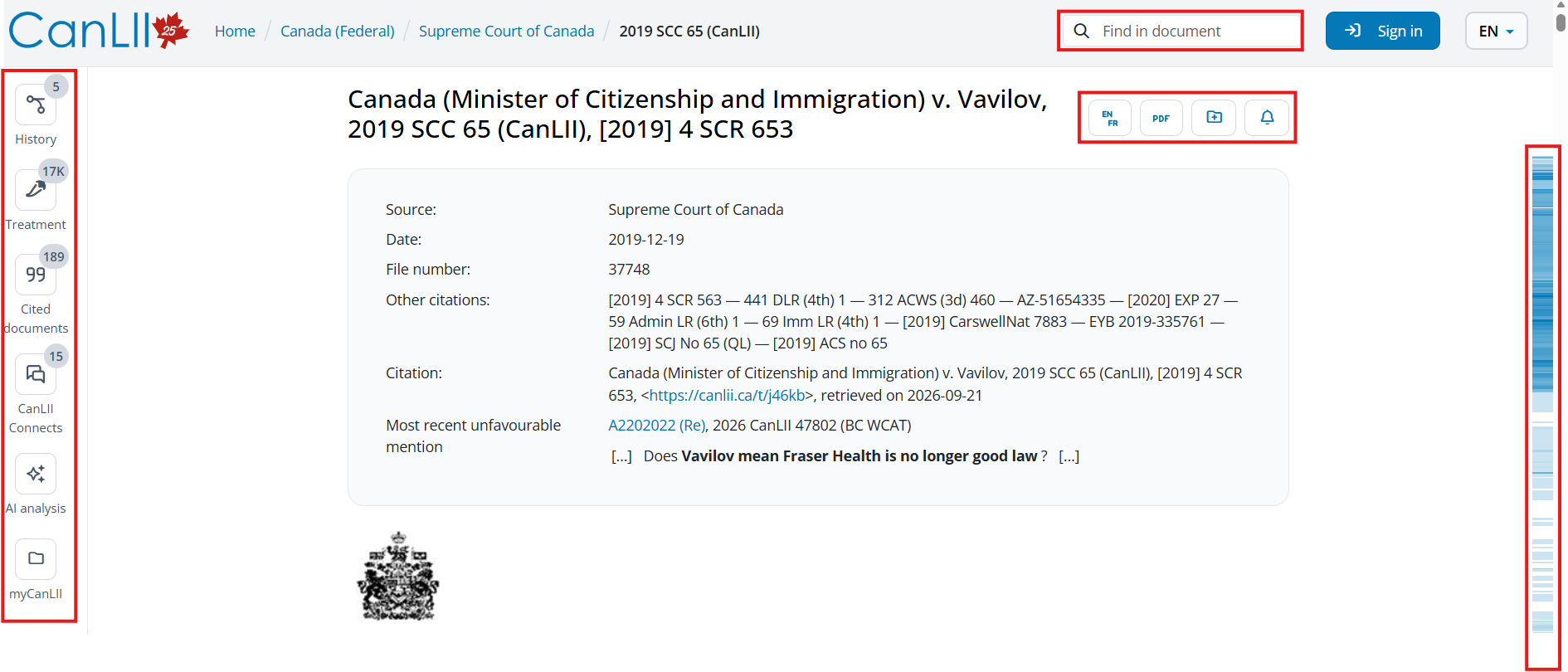
Once you have selected a document, right at the very top here, we have the “Find in document” search bar. Here, you can enter a word or use quotation marks to look for a phrase, hit enter, and this word will be highlighted where it appears on the page. There are also arrows that can help you skip through the document to those appearances and you can also edit your search. 

Next thing is the link to toggle between languages. Because this case came from the Supreme Court, it is available in both English and French, so CanLII has both. If you click on it, it will switch to French, but your interface will still be in English. 

You also have at the top a PDF link. If you want to download the document or print it.  

Immediately underneath is the rest of the case information – date, alternate citations, and then the citation you could reference for finding this on CanLII, you also have a short permanent URL, I encourage you to use this one if you link the decision in a document or in an email. You will be sure that the link will be working long term. Beneath that: Most recent unfavorable mention

Next is the left sidebar. Clicking on any of those options will open up the information contained within the tab in the same screen as the document you are looking at. First up is History. It lists decisions related to this case. Sometimes a decision is missing or unavailable.

After that is Treatment. The documents that cite this decision specifically. Within this tab, there are three sub sections. The first subsection is everything that cites this decision, including commentary. This is a list of the most recent. The second tab is discussions, documents that discuss the document you are viewing. The jalapeno peppers are to indicate intensity. The highest ranking is five peppers. Blue peppers are discussion and yellow are unfavorable mentions. The third tab is just for the yellow peppers, so unfavorable mentions. You will not get a full list from these tabs; only 10 documents. To see all these documents, click on the Search for all discussing documents at the bottom. This will bring all the search results from the previous screen. You can now add keywords to your search or choose a paragraph. There is no further analysis applied to these results than the peppers. You can also filter results in the same way than showed before.  

Next, we have the Cited Documents. These are cases or legislation that are cited within this decision. If it is in blue, you can click on the hyperlinked words, and that will open that document in full. You can also see where it is cited within the decision. Clicking on the eye icon will prompt CanLII to highlight the instances of this piece of legislation within your document, and you can use the arrows in the top right corner to scroll through the decision.  

Next is CanLII connect. This will take you out of CanLII and to CanLII Connects, which is a site with related commentary or case summaries from the legal community.

Next is the AI Analysis. You like the name it is an analysis of the case provided by an AI tool. It includes the facts, history, legal issues, reasons and more. 

Last one is myCanLII, so if you have an account you can add the decision to your research folder or create an alert. 

We have looked at noting up the decision before from the tab on the left hand side, but you can also note-up from within the text of the decision. Looking at a document on CanLII you will find these bubbles with a pen on the right side. When you click on it you have different options. Copy text, copy the citation of this paragraph, copy link, change the language, alerts and finally the citing documents. When the bubble has a number, it tells you that this section has been quoted elsewhere. The blue on the side bar also highlights sections that have been quoted. The darker the blue, the more that section has been cited. You can click on the bar to navigate in the decision or if you hover over it, you will have a view of the paragraph.  

If you click on the “Citing Documents” link, you will be sent to the same search-results screen we have seen before, but this time the results are showing just document that cite to that particular paragraph. 


Legislation 

CanLII legislation

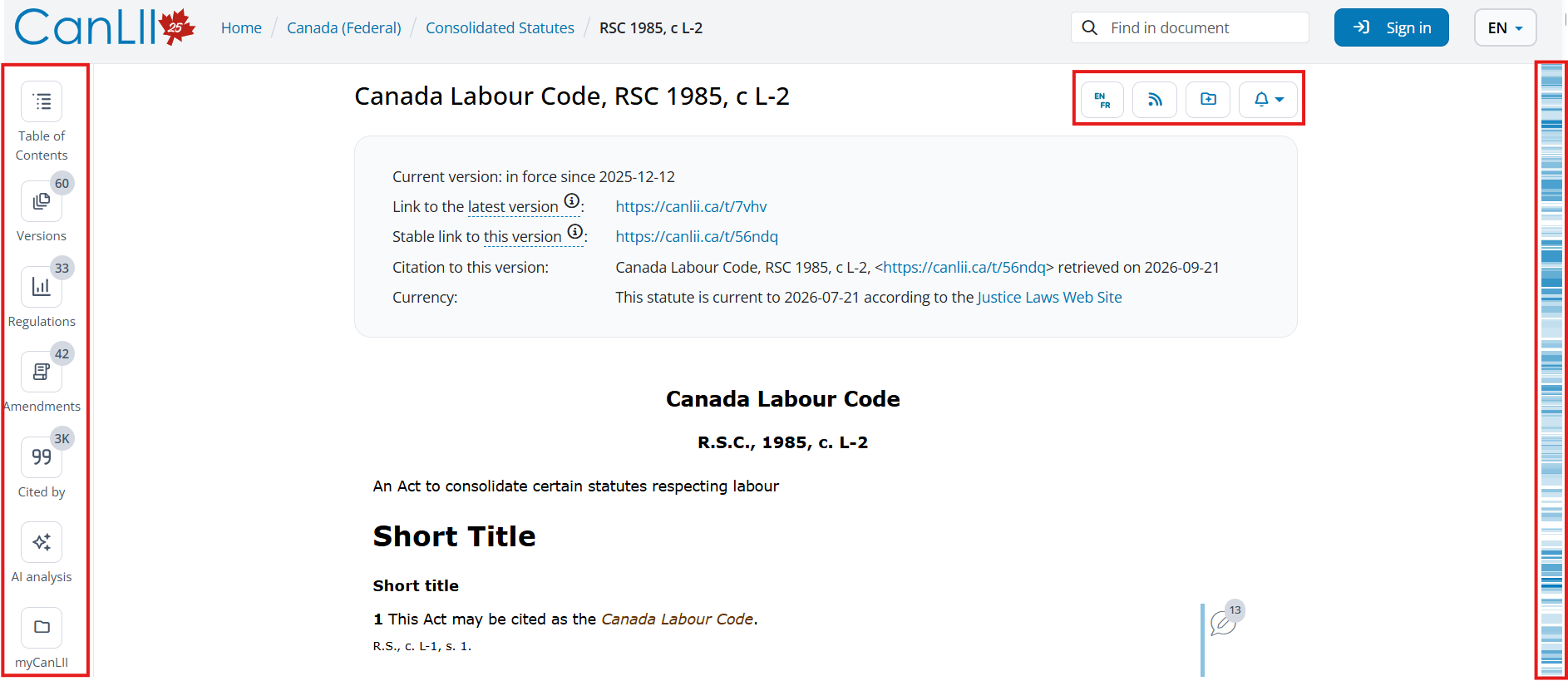
For legislation, it is very similar. You have the same options at the top, so language, PDF, etc. You also have the blue bar on the right, it works the same. Immediately under the name and citation, we have additional information about this document. You have the currency of the legislation prominently displayed. You can also see the last date it was updated and from where just below that. There are also permanent links.  

Moving over to the left-hand side, we have a series of tabs. The first here is the table of contents. When you click on this, we will again get a sidebar that pops out, that you can adjust, that has the table of contents for this document. Up at the top of this tab, you can also see a search box. It will search the content for what you put in there. 

Next is the versions tab. The default when you pull up this legislation from a basic search is the current version. You can click here on those blue hyperlinked date ranges to pull up the version of the legislation that was in effect in that specific date range. This will change what you are seeing on the right-hand side. You will note there is a warning at the top in red to indicate this is not the current version.  

If you want to compare two versions of the act, you need to select which versions you want to see the difference between. CanLII will go through and highlight differences. You can scroll through those differences using the arrow buttons at the top. I can see where a new section has been inserted into the act. You can also select other versions to compare from this page using the drop down menu at the top.  

Next, is the Regulations tab. In force regulations are at the top, repealed, spent, or not in force are at the bottom. There is a filter bar, so you can enter a term here, but it is only looking for that term in the title of the regulation, not the full text. 

Next tab is Amendments. This tracks amendments back to 2001 federally and in Ontario, but the coverage may be different for other jurisdictions. If you click on it, it will take you to the amending statute, the source law.  When you click on a document from this list, the tab that says “Amendments” in other legislation now says “amending” and list the legislation this amends.  

Finally, the last tab is Cited By. This is one of the ways that you can note up legislation. Just like with decisions, you will only get 10 results here. Click on Search for all citing documents to bring back all the citing documents for this legislation. The third box has the legislation we are looking at, and when you first click over here, it will be for any citation, any section. Again, you can add a section or more, and keywords. 

Another way to note up a section is to do that directly from the section you are interested in. You will see on the right hand side that there is a similar quotation bubble as we saw with decisions. You can click on that and get those same tools, but also a link to citing documents.  


CanLII Search+ 

CanLII Search+ is their new AI functionality. To use it, you will need to create an account, which is free.  

It does not work like most AI tools available on legal databases. It will not give you a direct answer or create new content for you, but will instead act as a research assistant, helping you create your search queries and analyze the results. It is not an AI tool that is going to hallucinate; it just maybe will not always give you the best results. It is great if you are not familiar with Boolean terms or if you are having difficulties formulating your queries. It can also be a faster way to find the decision you are looking for.  

CanLII Search+

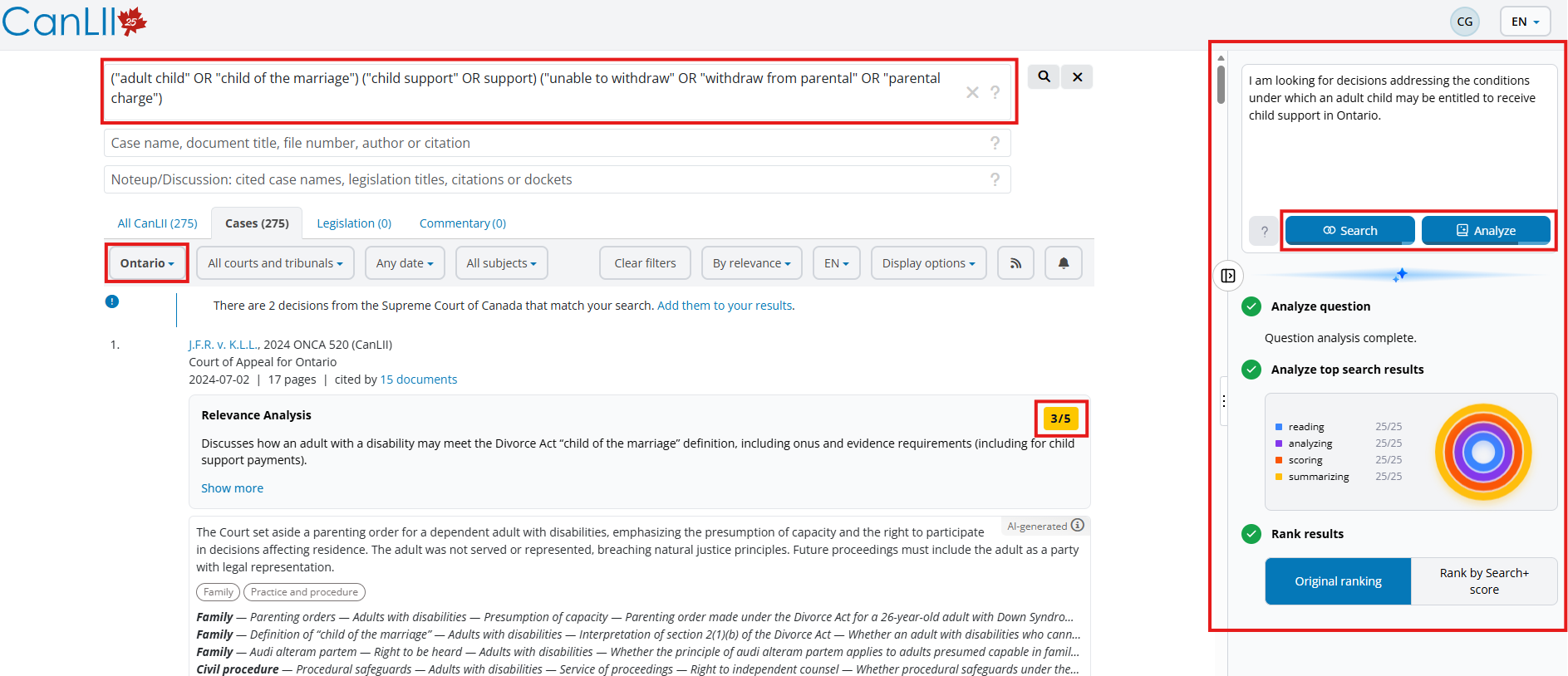
Once you are logged into your account, you will find the tool on the right side of your screen. You just need to write your question in the first box and click on Search

You will find the query in the first search box of the top of the page, and sometimes it will use the filters. You can then browse the results yourself or you can click on Analyze, and the tool will rate the results out of five. After it is done analyzing, you will see the scores on the right. You might want to check the higher scored decisions first.   

The tool is free, but you have a limited amount of research and analysis per day (10 searches and 100 documents analyzed). 

Even though this tool does not think for you, you need to be careful when using it like any other AI product. Double check the results and do your own research. You can also use the query it gives you on other databases or modify it. Try different words or Boolean operators.  

That is it for the CanLII training, do not forget to check and register to our upcoming training sessions – Library Events



Recently Published Ottawa Decisions

Find below recently published Ottawa decisions, available for free through CanLII.org.

Family Matters

DesLauriers v. Deochand (2026 ONSC 4840)
On a motion to vary a parenting order, the court finds a material change in circumstances due to the father’s cocaine addiction, relapses, CAS involvement, and instability. Applying the Divorce Act best-interests test, it grants the mother primary residence and sole decision-making, and orders the father’s parenting time supervised for six months.
Justice K. Jensen

K.S. v. S.N. (2026 ONSC 4741)
In a high-conflict parenting case, the Court awarded substantial indemnity costs of $20,456.56 due to the Applicant’s unreasonable conduct, including repeated non-compliance with court orders and actions undermining the Respondent’s parenting rights. The costs award was deemed reasonable and proportionate.
Justice M. Smith

Y.A. v. Y.M. (2026 ONSC 4913)
In a Divorce Act parenting application, the judge authorizes the children’s relocation from Ontario to Lyon, finding it best serves their well-being given the mother’s primary caregiving role, support network, and services for a child with autism. The mother receives sole decision-making. A phased parenting-time schedule and child support arrears/imputed income orders issue.
Justice K. Jensen

Civil Matters

6751067 Canada Inc. v. 16002731 Canada Inc. (2026 ONSC 4754)
The Court ruled that the vendor breached the duty of honest performance by withholding material lease termination information, justifying the purchaser’s refusal to close. The $150,000 deposit was ordered returned to the purchaser.
Justice A. Doyle

Bourque/Chima v. Public Service Alliance Of Canada et al (2026 ONSC 4761)
The Court ruled it lacks jurisdiction over claims arising from union disciplinary processes, finding the Labour Board is the appropriate forum.
Associate Justice K. Perron

Caivan (Greenbank) Inc. v. Balogun (2026 ONSC 4790)
The Court granted summary judgment for damages in a failed real estate purchase, finding no obligation to provide vendor financing and that the plaintiff’s mitigation efforts were reasonable. The defendants’ counterclaim was dismissed.
Justice A. Kaufman

The Estate of Sean Craddock et al. v. Daviau (2026 ONSC 4881)
In competing estate applications, the Court holds that a residual beneficiary had no proprietary right to occupy estate real property or block its sale, and that extrinsic statements of intent could not vary the will. The Estate Trustee obtained vacant possession within 60 days, occupation rent, and utility carrying costs; the beneficiary’s injunction and CPL requests were dismissed, with costs awarded.
Justice K. Jensen

Guttin v. Creber et al. (2026 ONSC 4507)
In a business dispute involving oppression claims, the Court awarded $50,000 in costs to each respondent, finding them more successful overall despite one act of oppression related to financial disclosure. The Court also directed the sale of a jointly owned property and distribution of proceeds under specific conditions.
Justice A. Doyle

Kajjouni et al. v. Sebrins et al. & Kajjouni v. Promutuel (2026 ONSC 4973)
On a case conference motion for procedural orders, the Court held it lacked jurisdiction simpliciter over claims against a Quebec insurer arising from a Quebec insurance contract and benefit administration. Applying Van Breda, no presumptive connecting factor linked the contractual dispute to Ontario. The consolidation request was moot.
Associate Justice I. Kamal

Lual v. Sir John A. Pub – Ottawa (2026 ONSC 4870)
On a motion to strike, the court holds the claim pleads insufficient material facts for intentional infliction of mental suffering, defamation, and economic loss, and that refusal of service/trespass allegations are essentially discrimination matters for the Human Rights Tribunal of Ontario. The claim is struck, with leave to amend except those discrimination-based claims.
Justice A. Doyle

Nakanwagi v City of Ottawa et al (2026 ONSC 4995)
On a case conference addressing a plaintiff’s motion, the judge held that the 60-day notice requirement in s. 18 of the Crown Liability Proceedings Act is mandatory and cannot be waived. Because the claim was issued before the notice period expired, it was a nullity against the Crown and dismissed, while continuing against the municipal defendant.
Associate Justice I. Kamal

Sunday Irving Holdings Inc. v. La Succession De Seymour Mender et al (2026 ONSC 4687)
On a Rule 30.06 production motion, the court orders a further and better affidavit of documents and targeted production about condominium window bylaws and reserve fund issues. It finds some requests irrelevant, rejects broad “fishing” requests, and limits solicitor-client privilege waiver to the legal opinions shared with owners and the facts and documents provided to counsel.
Justice A. Doyle

Criminal Matters

Johnson v. Ontario (2026 ONSC 4965)
On a motion to strike an application, the Court holds the proceeding is an abuse of process and a collateral attack on a firearms forfeiture order made under s. 490(9) of the Criminal Code. Any challenge had to proceed by appeal under s. 490(17). The application is struck without leave to amend and dismissed.
Justice M. Smith

R. v. E.D. (2026 ONSC 4933)
In a criminal trial for sexual assault of a 12-year-old, the judge found the complainant credible on the storage-room allegation and rejected the accused’s denials under W.(D.). Although an earlier alleged breast touch during a height comparison was not proven beyond a reasonable doubt, the accused was convicted.
Justice A. Kaufman

Continue reading

LLMC – find historical documents easily

We are excited to announce you can now have access to LLMC from the Library and the database is also available for use remotely at your own office! If you are looking for an historical document, that’s the tool for you! LLMC is a nonprofit library that collects, preserves and digitizes historical documents from around the world. Their collection keeps growing every year. You can find on this database, legislation, law reports, journals and newspapers, official gazettes, treatises and more. This access was made possible through the Great Library (Legal Information and Resource Network).

LLMC homepage

How to Get Remote Access

LLMC is available both here at the library and remotely through your LSO resource portal. LLMC, Rangefindr.ca and HeinOnline use the same username and password, so if you are already able to access the last two, please skip this step.

If you don’t already have your access – here’s the link with all the information to set it up: Library eResources Sign-In Instructions for LSO Licensees  – FAQs

Once you have your account information, your can sign in with this link: LLMC. Don’t forget to bookmark it!


Training

LLMC offers a few webinars per year. Both fall sessions have already taken place, we will keep you posted for the next ones.

Recently Published Ottawa Decisions

Find below recently published Ottawa decisions, available for free through CanLII.org.

Family Matters

Burkay v. Walker (2026 ONSC 4744)
The Court stayed the application, ruling that a separation agreement’s arbitration clause is enforceable despite non-compliance with formal family arbitration requirements, provided the parties take steps to execute a compliant agreement.
Justice A. Kaufman

C.D. v. J.A. (2026 ONSC 4735)
In a high-conflict parenting dispute, the Court prioritized the adolescent child’s well-being by terminating mandatory parenting time and communication schedules, allowing the child to control contact with her father. Both contempt motions were dismissed, and the father was restricted from filing further motions without leave due to repetitive litigation.
Justice K. Jensen

Mohamed v. Mohamed (2026 ONSC 4346)
The Court dismissed a motion seeking enforcement of parenting orders for a 32-year-old adult with disabilities, citing lack of jurisdiction under family law legislation. The matter was redirected to the Substitute Decisions Act for addressing care and capacity issues.
Associate Justice I. Kamal

Civil Matters

Guergis v. Hamilton et. al (2026 ONSC 4804)
In a defamation case, the Court allowed a defendant to amend their statement of defence to specify statutory limitation defences under the Libel and Slander Act. The Court found no presumed or actual prejudice to the plaintiff, emphasizing that delay alone does not bar amendments if prejudice can be addressed through costs or adjournment.
Associate Justice I. Kamal

In the Matter of the Bankruptcy of Elizabeth Susan McLean (2026 ONSC 4656)
The Court imposed a conditional and suspended discharge in a bankruptcy case, emphasizing addiction recovery as integral to financial rehabilitation under the Bankruptcy and Insolvency Act. Conditions included addiction counselling, 12-step meeting attendance, and periodic court check-ins to ensure compliance and progress.
Associate Justice I. Kamal

Jason Lappan v. Estate of Florence Bevins et al (2026 ONSC 3722)
The Court dismissed an application for dependant’s support, finding that the adult child with disabilities was not financially reliant on the deceased parent, as his needs were met through government benefits and institutional support. Even if dependency were established, the will’s provisions were deemed adequate and equitable.
Justice K. Jensen

John Raphael McMahon, Executor and Trustee Under the Last Will and Testament of Douglas Sargent Montgomery, Deceased v. Montgomery (2026 ONSC 4552)
On a motion to set aside a registrar’s delay dismissal, the Court applies the Reid criteria and takes a contextual approach. It finds a reasonable overall explanation tied largely to the defendant’s capacity and litigation guardian issues, the motion was brought promptly, and there was no prejudice. The action is restored.
Associate Justice K. Perron

Kemdirim v. Mahiagbe et al (2026 ONSC 4553)
The Court awarded $5,000 in costs to the defendant after the plaintiff discontinued the action late in the proceedings. The Court emphasized the timing of the discontinuance, the principle of indemnity, and the proportionality of legal fees incurred, while rejecting claims for the defendant’s personal time as a self-represented litigant.
Associate Justice K. Perron

Michaud et al v. Li (2026 ONSC 4451)
A motion to set aside a costs order alleging fraud was dismissed. The Court found no deliberate misrepresentation or fraud, emphasizing the importance of finality in litigation.
Justice O. Rees

TD Bank v. 1633092 Ontario Ltd. (2026 ONSC 4620)
The Court found the bank breached a loan agreement but ruled the breach did not cause the business’s failure, dismissing damages claims.
Justice R. Smith

Wright v. General Motors Financial of Canada, Ltd. et. al. (2026 ONSC 4760)
The Court approved a class action settlement addressing a data breach, finding the agreement fair, reasonable, and in the class’s best interests. Compensation includes credit monitoring, identity theft insurance, and monetary payments to affected individuals, with a streamlined claims process ensuring efficient distribution.
Justice C. MacLeod

Criminal Matters

His Majesty The King v. A.N. (2026 ONSC 3919)
The Court imposed a conditional discharge with probation for forging a consent letter, citing emotional duress, remorse, and collateral immigration consequences.
Justice A. London-Weinstein

R. v. A.G. (2026 ONSC 4367)
The Court sentenced the Accused to 10 years’ imprisonment for repeated sexual and physical abuse of his adopted children, emphasizing denunciation, deterrence, and the profound breach of trust. Ancillary orders included a 20-year SOIRA registration, DNA collection, and restrictions on contact with minors. Parole eligibility was delayed to half the sentence.
Justice K. McVey

R. v. Bernier (2026 ONSC 3213)
The Court dismissed a motion to extend the time to appeal convictions entered after guilty pleas, finding no bona fide intention to appeal, insufficient explanation for delay, and no merit to the proposed appeal. The plea was deemed voluntary, informed, and final, with no exceptional circumstances warranting reopening.
Justice A. Doyle

Continue reading

New Titles – August 2026

See the list below for all new materials now available at the CCLA library!

New in Print
Available for in-library use. Find the call number through the CCLA Catalogue or contact library staff for help.

New Electronic Resources
Available in-person through the CCLA Library Toolkit.

New CPD
Available remotely through LSO CPD Materials.

Recently Published Ottawa Decisions

Find below recently published Ottawa decisions, available for free through CanLII.org.

Civil Matters

Anishinabeg v. AGC et al., (2026 ONSC 4430)
The Court granted one group’s motion to intervene in a representation motion under Rule 12.08 but dismissed another’s, finding their interests were either directly relevant or speculative and beyond the motion’s scope.
Justice M. Flaherty

Barkey v. Doe (2026 ONSC 4390)
The Court ruled that the plaintiff could not identify the other driver due to a concussion and granted relief from forfeiture despite delayed notice to the insurer, finding no irreparable prejudice caused by the breach of statutory notice requirements. The plaintiff provided sufficient corroborating evidence of the unidentified vehicle’s involvement.
Justice R. Smith

Claridge December Holdings Inc. v. Co-operative d’Habitation Desloges Inc. (2026 ONSC 4381)
The Court ruled that a resulting trust arose after an express trust failed due to unmet Planning Act conditions. Legal title was vested in the applicant, while the respondent was partially compensated for maintenance costs incurred on the disputed land.
Justice O. Rees

Dawson et al v. Dawson et al., (2026 ONSC 4215)
The Court invalidated wills and powers of attorney due to undue influence by a son over his elderly parents, despite finding no lack of testamentary capacity. The son was also ordered to pass accounts for his management of their finances.
Justice M. Labrosse

National Bank of Canaca v. Ocm Auto Financing Ltd. (2026 CanLII 74017)
The Court appointed an interim receiver to protect a creditor’s interests, citing the debtor’s defaults, mismanagement of trust funds, and lack of transparency. The decision emphasized the necessity of preserving assets and ensuring compliance with agreements while limiting the receiver’s powers to interim measures.
Associate Justice K. Perron

Premiere Construction Ltd. v. 444 Bronson Development Inc. et al., (2026 ONSC 4426)
The Court ordered three construction-related proceedings to be heard consecutively on a common timetable, citing overlapping issues, witnesses, and risks of inconsistent findings. The decision emphasized procedural efficiency and rejected a request for partial bifurcation, finding it would complicate and prolong the litigation.
Associate Justice I. Kamal

Criminal Matters

R. v. Mills (2026 ONCJ 426)
The Court sentenced the Accused, who pleaded guilty to attempting to kill a family cat, to 18 months probation. The sentence emphasized denunciation and deterrence while considering mitigating factors, including the Accused’s remorse, lack of prior record, and efforts to address alcohol addiction. A discharge was deemed inappropriate.
Justice D. Berg

R. v. Northrup (2026 ONSC 4242)
The Court acquitted the accused of all charges, including uttering threats and firearm offences, citing credibility issues with the complainant’s testimony and the accused’s plausible account, which raised reasonable doubt.
Justice O. Rees

Divisional Court Decisions from Ottawa Judges

Waring’s Creek Improvement Association v. The Corporation of the County of Prince Edward et al., (2026 ONSC 3977)
A motion to transfer an application to quash municipal by-laws was dismissed. The Court found the procedural illegality lacked substantive merit, as the by-laws could be reapproved without affecting the outcome or causing substantive harm. The potential prejudice to the development project also weighed against granting the transfer.
Justice M. Labrosse

Court of Appeal Decisions of Local Interest

R. v. Crossley (2026 ONCA 540)
The Court dismissed the appeal, finding no errors in the jury instructions or evidentiary rulings. The appellant’s conviction for intimidating a justice system participant was upheld, as the Crown proved the offence as particularized in the indictment. A dissenting judge would have acquitted on one count due to insufficient proof.
Justices J.M. Fairburn, D. Paciocco, and D. Wilson

Pringle v. Zenova Group PLC (2026 ONCA 549)
The Court ruled that the appellant was an employee under Ontario’s Employment Standards Act, voiding the forum selection clause in his contract. The Ontario court retained jurisdiction, rejecting England as a more convenient forum, and allowed the wrongful dismissal claim to proceed in Ontario.
Justices K. van Rensburg, B. Miller, and L. Sossin

Smith v. Nagy (2026 ONCA 545)
The Court dismissed an appeal challenging the burden of proof in sexual battery and defamation claims, affirming that defendants in battery cases must prove consent, while defamation defendants must prove the truth of their allegations. Despite a trial judge’s error in burden allocation, no miscarriage of justice occurred.
Justices D. Paciocco, J. Thorburn, and J. George

Recently Published Ottawa Decisions

Find below recently published Ottawa decisions, available for free through CanLII.org.

Civil Matters

Selleck v. Stanutz (Estate) et al. (2026 ONSC 4219)
The Court ordered interest on delayed settlement funds, partially at a higher rate reflecting litigation loan costs, and quantified costs, including partial indemnity costs for a hearing.
Justice C. MacLeod

Stewart Title v. Hutchinson et. al. (2026 ONSC 4190)
The Court granted default judgment against a disbarred lawyer for misappropriating real estate funds, awarding compensatory damages, costs, and $25,000 in punitive damages due to the egregious breach of fiduciary duty.
Justice C. MacLeod

Criminal Matters

R. v. Khreis (2026 ONSC 4051)
The Court convicted the Accused of sexual assault, robbery, and theft under $5,000, relying on complainants’ credible testimony, circumstantial evidence, and similar fact evidence to establish identity, intent, and modus operandi beyond a reasonable doubt.
Justice S. Corthorn

R v. Noseworthy (2026 ONSC 4221)
An appeal of a conviction for refusing a breath sample was dismissed. The Court found the trial judge reasonably concluded that the delay in making the demand was justified by unusual circumstances, including safety concerns near rapids. No legal errors or misapprehension of evidence were identified.
Justice P. Roger

R v. Omer (2026 ONSC 4263)
The Court partially granted an accused’s application to release seized funds for legal fees, finding he lacked other financial means. Despite limited evidence, the Court accepted his affidavit and hearsay about Legal Aid ineligibility, balancing the presumption of innocence with the principle that crime should not pay.
Justice P. Roger

Court of Appeal Decisions of Local Interest

R. v. King (2026 ONCA 522)
The Court overturned an acquittal, ruling that blocking highways during protests can constitute intimidation under the Criminal Code. It clarified that political protest does not justify illegal conduct, and substituted a conviction for the accused’s role in obstructing Ottawa roads during the Freedom Convoy.
Justices D. Paciocco, L. Madsen and, R. Pomerance

R. v. S.W. (2026 ONCA 531)
The Court upheld the dangerous offender designation, dismissed ineffective counsel claims, and increased the sentence from 17 to 25 years for severe child sexual abuse and exploitation, emphasizing the offender’s role in administering a global CSAEM website.
Justices J.M. Fairburn, D. Wilson and, M. Rahman

New Titles – July 2026

See the list below for all new materials now available at the CCLA library!

New in Print
Available for in-library use. Find the call number through the CCLA Catalogue or contact library staff for help.

New Electronic Resources
Available in-person through the CCLA Library Toolkit.

New CPD
Available remotely through LSO CPD Materials.

Recently Published Ottawa Decisions

Find below recently published Ottawa decisions, available for free through CanLII.org.

Family Matters

Agostini v. Rochdi (2026 ONSC 3720)
In a family law dispute, the Court ordered supervised parenting time and granted sole decision-making responsibility to the mother, citing the father’s persistent emotional harm to the children through unfounded abuse allegations and inappropriate behaviour. A restraining order was also issued to protect the mother and children.
Justice J. Audet

Civil Matters

1995636 Ontario Inc. et al v. 5010729 Ontario Inc. et al (2026 ONSC 3723)
The Court denied a motion to amend pleadings to add new defendants, citing non-compensable prejudice and disruption to defendants’ counsel. Plaintiffs were awarded partial costs for a withdrawn production motion due to defendants’ delayed compliance with prior court orders.
Justice M. Labrosse

Air Passenger Rights v. The Attorney General of Canada (2026 ONSC 3983)
The Court ruled that confidentiality provisions in air passenger complaint processes violate the open court principle and freedom of expression under the Charter. It ordered the provisions to apply only to mediation records, not adjudicative decisions, as the process remains adjudicative in nature.
Justice C. Hackland

Hauser v. Phalan R.C. Flying Club Inc. et. al. (2026 ONSC 3984)
The Court dismissed a motion to transfer and consolidate Small Claims Court actions with a Superior Court proceeding, emphasizing the integrity of the small claims process and finding no justification for the transfer. The Superior Court action was stayed pending resolution of the small claims trial.
Justice C. MacLeod

Lantaigne et al v. Whitten & Lublin et al (2026 ONSC 3731)
A motion to amend or vary a costs order under Rule 59.06 was dismissed. The Court found no accidental error, newly discovered facts, or other exceptional circumstances justifying relief. Rule 59.06 cannot be used to reargue issues or introduce new evidence that could have been presented earlier.
Associate Justice I. Kamal

Mattamy (Jock River) Limited v. Tripple S & A Inc. (2026 ONSC 4012)
The Court granted summary judgment to the vendor, finding no defence to the purchaser’s breach of a binding real estate agreement. Damages were awarded for the price shortfall and related expenses, with minor reductions for insufficient evidence on certain costs. Costs of the action were also awarded.
Justice C. MacLeod

O’Regan v. Harman and Romain (2026 ONSC 4066)
The Court struck a negligence claim against an appraiser, ruling it was barred by witness immunity and lacked sufficient factual basis.
Justice S. Corthorn

Parris v. Firmenich International SA et. al. (2026 ONSC 3922)
A proposed class action alleging a global fragrance price-fixing conspiracy was denied certification. The Court found insufficient evidence to meet the “some basis in fact” test, citing vague allegations, unmanageable class definitions, and lack of proof of wrongdoing or damages in Canada.
Justice C. MacLeod

Shapiro v. Shapiro (2026 ONSC 3834)
The Court awarded costs in an estate dispute, emphasizing proportionality and success. Public policy justified partial estate-funded costs for a dependency claim, while the unsuccessful will challenge resulted in costs payable by the objectors.
Justice K. Jensen

Wadie Narouz v. Fisgard Capital Corporation Also Known As Fisgard Asset Management Corporation (2026 ONSC 3060)
In a mortgage enforcement case, the Court granted leave to issue a writ of possession, rejecting Charter arguments as inapplicable to private litigation. The plaintiff’s claims of surveillance and delay in receiving a French translation were dismissed, and costs of $15,000 were awarded to the defendant.
Associate Justice M. Fortier Continue reading

Recently Published Ottawa Decisions

Find below recently published Ottawa decisions, available for free through CanLII.org.

Family Matters

Anderson v. Parsons (2026 ONSC 3530)
In a family law dispute, the Court dismissed a motion to strike pleadings, upheld existing support orders, and ordered the sale of the matrimonial home with equal division of proceeds. The child’s school placement remained unchanged, prioritizing stability and best interests. Costs were awarded to the respondent.
Justice P. Roger

Pontallier v. Ibironke (2026 ONSC 3429)
The Court imputed income to a father, finding intentional underemployment and inconsistent financial disclosure, and ordered retroactive child support and proportional contributions to childcare expenses. The father’s claims of shared parenting and financial hardship were rejected due to insufficient evidence and discrepancies in his testimony and financial records.
Justice M. Sirivar

Civil Matters

9409394 Canada Inc. v. Ghislain Lascelles (2026 ONSC 819)
A property owner failed to establish adverse possession over a disputed driveway strip but succeeded under proprietary estoppel. The Court found the respondent’s 30-year silence and the applicant’s detrimental reliance made it unconscionable to deny the applicant continued use of the full driveway. The respondent must remove a dividing fence.
Justice M. Flaherty

Levy v. Crawford & Company (2026 ONSC 3581)
The Court dismissed a motion to strike claims for negligent misrepresentation and oppression, finding the pleadings sufficiently disclosed reasonable causes of action. The Court emphasized that proximity and duty of care required a fuller factual record and that oppression claims were not precluded by contractual remedies.
Justice P. Roger

Louis Jones Construction Ltd. v. Jonathan Rocque o/a J-Rock Construction, Roxanne Rocque and Caisse Populaire Trillium Inc. (2026 ONSC 3159)
The case involved construction liens and a quantum meruit claim arising from foundation work. The Court found the liens untimely under the applicable legislation and dismissed the quantum meruit claim due to insufficient evidence. A breach of contract claim by the defendants was also rejected.
Justice M. Flaherty

Criminal Matters

R v. Kongkhaw, McPolin, and Lafontaine (2025 ONSC 7326)
The Court upheld most judicial authorizations for investigative procedures in a drug-trafficking case, rejecting claims of subversion of the pre-authorization process. It found no evidence of intentional misconduct by the affiant, despite drafting flaws and omissions, and declined to quash the authorizations collectively or individually.
Justice S. Corthorn

R. v. McPolin (2026 ONSC 3493)
The Court sentenced the Accused to 27 months’ imprisonment for firearm possession offences, emphasizing deterrence and denunciation over rehabilitation.
Justice S. Corthorn

R c Vien (2026 ONCS 110)
Dans une affaire criminelle concernant des menaces de mort, le Tribunal a conclu à un doute raisonnable en raison de l’intoxication de l’accusé et de la faible crédibilité du témoin principal, déclarant l’accusé non coupable.
Juge P. Roger

Court of Appeal Decisions of Local Interest

R. v. Babor (2026 ONCA 428)
The Court admitted fresh evidence but upheld the finding of not criminally responsible (NCR) due to mental disorder. Procedural errors, including limiting cross-examination and excluding a psychologist’s testimony, were deemed non-prejudicial. The appellant’s absolute discharge from the Ontario Review Board remained unaffected. Appeal dismissed.
Justices J.M. Fairburn, P. Monahan, and P. Osborne

R. v. Blanco (2026 ONCA 433)
The Court restored a sexual assault conviction, finding the trial judge properly concluded that any apparent consent was vitiated by the accused’s abuse of his position of trust, despite conflicting evidence on subjective consent. The summary conviction appeal judge erred in interpreting the legal test for vitiation of consent.
Justices G. Huscroft, J. Thorburn, and J. Dawe