Searching Federal Hansard Debates

Way back when I did a post about how to search through the Ontario Hansard Debates online, I made a note to myself to follow up with a companion Federal Debates post. This is me following up, after more than a year. Because, well, insert something about dedication (or stubbornness).

As it seems with all things in Canadian Law, online access to the Federal Debates of Parliament (“Hansard”) are scattered across several different websites, and your mileage may vary with each.

  1. Parliament of Canada / LegisInfo – If you’re lucky enough to be dealing with a piece of legislation from 1994 onwards (and the later you go generally the more linked content you will get for each Bill), the main Parliament of Canada website will most likely work well for you. You can trace Bills, click through to their linked debates, and see the reports from related committees.
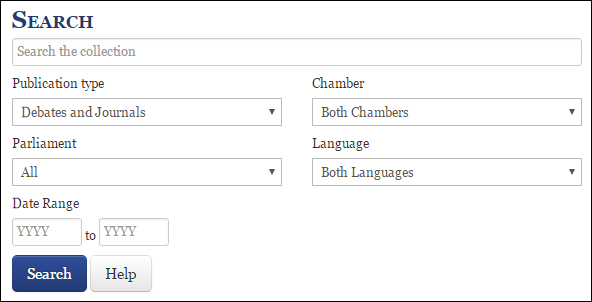
  2. Canadiana – For earlier debates, use Canadiana.org’s Parliamentary Historical Resources site through the Library of Parliament. This site has the debates from both the Senate and the House of Commons, in both official languages, back to Confederation. The only downside here is that the search engine can be a little finicky. I’ve had the most success with it by narrowing the date range to the date you are interested, and searching the Bill number (not the chapter number of the Act), if you know it.
parl

Like the rest of legislative research, trying to find Legislative Intent is unfortunately not an exact science, but hopefully the above should assist in getting you started. Also, I love doing this kind of research, so please don’t hesitate to let us know should you need assistance! 

Sites Unseen: Ravel Law

Last year I wrote a post on how to find free online access to American Case Law for us here in Canada. Well let’s add Ravel Law to that list!

While Ravel Law does operate as a subscription-based platform, some of its features, including its case law database, are available for viewing for free online (downloading the case is disabled unless you subscribe, however). It also offers additional features you would not get from the other free sources, such as the ability to visually map out references of a certain case:

ravellaw

Hovering over the different case circles will allow you to visualize which cases refer to which others. You can also narrow by date range or by court, and clicking through to the case on the right will open up the full text for you to view.

While some of its free features are limited, Ravel Law still seems to be a great source for those looking for free access to American case law, and its search visualization features are definitely fun to play around with!

Resource Spotlight: Bullen & Leake & Jacob’s Canadian Precedents of Pleadings

Once a month, Robeside Assistance will feature a resource that we purchase for the library that you might not know we have. Our collection is full of great books, databases, programs, and other materials, so definitely visit us in the library if you’d like to use anything mentioned here!

BLJ

If pressed to name our favourite books in the library, Brenda and I would both include Bullen & Leake & Jacob’s Canadian Precedents of Pleadings in our top three. Tucked away in the civil litigation section, this gem of a title seems to always provide just what we need, when we need it. Based on the long-published British book of similar name (Bullen & Leake & Jacob’s Precedents of Pleadings, currently in its 18th edition), this book offers a huge selection of sample pleadings in a wide variety of legal areas. I find myself reaching for this book when asked for sample personal injury pleading examples, and Brenda has used this for the construction pleadings as well. You can take a browse through the impressively detailed table of contents here.  The book came with a CD-ROM, too, which has copies of the precedents contained in the book. No need to re-type – just let us know at the Reference Desk that you’d like to use the CD and you can take home copies of the precedents you that need, ready to be modified.

If you’d like to look through this excellent resource yourself, you can find it in our Texts section at KF 8868.1 B85 2013.

Sites Unseen: Osgoode Digital Commons

We always keep our eyes out for little-known or used sites that might assist in legal research, which we will feature in our new series: “Sites Unseen”. First up to the plate:

Osgoode Law School Digital Commons

Hands-down one of the most time-consuming legal research tasks is legislative research; that is, trying to trace the law to find out what it looked like in a certain year, updating it with amendments, finding copies of older orders-in-council, etc. It is mostly time-consuming because if you are interested in a year prior to the early 2000s, very little is available online and you will mostly be working with the bulky print volumes of statutes or regulations.

Fortunately, the Osgoode Law School at York University has made considerable strides in assisting in this area and now offers pdfs of Ontario Annual Statutes back to 1970, and Ontario Revised Statutes back to 1914. What is even better, as can be seen below (click to enlarge), is they are broken down into separate pdfs and fully browsable by the individual acts (goodbye 400+ page pdfs!):

osgoodedigitalcommons-1
Statutes are fully browsable by Act

So if you need a copy of an older Ontario Act, bookmark this site and have a look! I use it constantly in my legislative research here, even just to to get a cleaner-looking scan of a particular Act.

They also have digital copies available of all the old Ontario Law Reform Commission reports, something we get questions about as well.

Improved Search Function in WestlawNext Canada

There’s an exciting new feature in WestlawNext Canada that we just had to share with our legal research keeners. Brenda and I cheered out loud when this feature launched a few weeks ago, it’s that exciting!

From any page on WestlawNext Canada, you can now do a targeted search by clicking on the “Find” button at the end of the white search box. This will open the “Find Dropdown” template, which is a search box that gives you the option of retrieving materials by case, statute, or regulation name or citation.

The benefit of using this template is that when you know what you’re trying to find on WestlawNext (a certain case, a specific section of an act, etc.), as opposed to running a general keyword search, this will bring those documents up to the top of your results list, and not flood your results with documents you don’t need. Try it out, and let us know how it works for you!

Research Tip: Ontario Labour Agreements

This legal research tip comes from In Session, the monthly newsletter of the Canadian Association of Law Libraries (CALL). Check it out:

Finding a copy of a collective agreement in Ontario is now easier than ever before! All collective agreements in Ontario are now available online through the Ministry of Labour’s Collective Agreements e-Library Portal. They are searchable by full text and also categorized by industry type. Collective agreements are available as downloadable pdf documents. A full list of all employer and union relationships in the province is also available through the Portal.

For further questions, contact Collective Bargaining Information Services: cbis@ontario.ca.

Here are some other frequently difficult to find labour resources:

Ontario Union Bargaining Certificates: Use the OLRB certificates database, a collection of certificates from 2007 to date. For older certificates from 1962 contact the Ontario Workplace Tribunals Library 416-314-3700 or owtl@wst.gov.on.ca. They will email .pdf copies free of charge.

Ontario Labour Arbitration Decisions: For unreported decisions contact the Ministry of Labour Arbitration Services at 416- 326-1300 or mol.arbitrationservices@ontario.ca. (CCLA Note: for reported decisions, Quicklaw has the best coverage, with a complete run from 1992 to the present as well as over 2700 significant decisions from 1949 to 1991.)

Ontario Education Relations Commission Decisions (ERC): Contact Ministry of Labour, Collective Bargaining Information Services at 416-326-1260 or cbis@ontario.ca.

Research Tip: CCLA Conference Papers Database

It’s not surprising we get a lot of requests for conference papers from our own four annual cornerstone conferences: Family Law Institute, East Region Solicitors’, DCAO Criminal Law, and Civil Litigation Updated.

What more people don’t know is that we post the papers on our website in CCLA Conference Paper Database afterwards! So even if you aren’t able to attend, you can check out what sessions were held and keep up to speed on the current issues in the profession. They are also useful for specific practice directions for the East Region, or summaries of recent local cases and precedents.

The easiest way to search is by author. For example, I’m looking for Justice Mackinnon’s papers here:

When I hit search, I’ll get a results screen with all of her papers:

confpapers2

And now I can browse and download whichever ones I am interested in by clicking on the link next to the PDF icon. If I do not know the author, I can also search by subject. Additionally you can search by specific conference and year by clicking on the “Advanced Search” button on the main search screen.

It’s a great way to keep apprised of the work of the local bar!

As always, we’re here to help, so let us know if you have any difficulties finding papers from our events and we’ll see if we can send them to you. The database goes back to 2001, but we are often able to scan and send papers from prior to that as well!


How to Find Unreported Decisions

“I can’t find this case. I think it might be unreported.”

We get a lot of requests at the library for help in finding a specific case. Here are the steps to figuring out if the case is unreported, and what to do about it:

1. Have you checked CanLII, Quicklaw, and Westlaw? 

There is no one complete source for reported decisions. Finding decisions would be much easier if there were, but unfortunately there are some cases that Quicklaw will have, and Westlaw won’t, and vice versa. As the CCLA Library has both Westlaw and Quicklaw, you can always check with us to see if the case is available on any of these services. As always, there’s no charge for this. Sometimes the source you see noting the case will say it’s unreported – it’s still worth it to check. Cases have a way of showing up online well after they were declared “unreported,” and it’s an easy enough check to make before you go into the next steps.

2. Is it foreign? Only available in a print reporter?

This next step is another where it’s good to run it by us at the Library. Often times, people are actually looking for British cases and don’t realize it. Or, the case might be available, but only in old print reporters. We can quickly and easily check on these options for you.

3. The decision is truly unreported.

In the event that the decision you’re after is truly unreported, there are a few options:

  • Contact counsel from the case
    • This is an option that skirts the following process with the courts, if you’re comfortable doing this.
  • For Ottawa decisions:
    • The Ottawa Courthouse retains case files until the matter is closed. Contact the correct court (civil, family, or criminal) and request a copy.
    • After a period of time, case files are sent to the Records Centre of the Ministry of Government Services in Cooksville. The court here will recall that document for you – you cannot go to them directly.
    • You will need to pay a recall fee (currently $61.00) at the courthouse to bring the file back. There is also a viewing fee (currently $10.00) to look at the file once here. If you were a party to the file, you can view it for free (but still have the pay the recall fee). You may make a photocopy of the file at the counter (bring change: their copier accepts coins).
  • For decisions from elsewhere in Ontario:
    • The retention schedule for other courthouses may vary. If you need to get in touch with a courthouse in another area, you can find their phone numbers here.
    • The Ottawa courthouse cannot recall these files for you.

4.  Bonus! “I don’t know where this case was heard originally.”

This definitely comes up from time to time – a case is unreported, and you’re not sure where the decision was actually handed down, thus not being able to contact the courthouse. If you don’t know already and can’t figure it out from what you’ve been told or the context you found the case in, you can also come to us for help. Here is what we would check to see if you had available:

  • Judge’s name
  • Counsel’s name
  • Any news stories that might shed light on the location or other identifying information
  • Details from the Higher Court decision (if looking for the unreported Lower Court decision)

Related, here are a few links relevant to carrying out legal research with hard to find documents:


From Your Library: WestlawNext CriminalSource

Criminal lawyers – this is for you! We here at the library are very excited to announce that our library subscription to Westlaw now includes the CriminalSource package.

CrimSource


Loads of looseleaf titles that you’ve come to rely on over the years are now easily searchable and printable from any of the seven computers in the library, as well as numerous newsletters, journals, and other goodies. Here’s a sample of some of the contents:

  • Ewaschuk’s Criminal Pleadings & Practice in Canada
  • McWilliams’ Canadian Criminal Evidence
  • Gibson’s Canadian Criminal Code Offences
  • Mack’s Criminal Law Bulletin
  • Criminal Law Quarterly
  • Nadin-Davis: Canadian Sentencing Digest

And so much more. Also included in the subscription are PDF scans of cases from the original law reporters. We get requests for those quite often, so this will be an enormous time-saver for you when you’re getting ready for court.

To help get you going with this product, we will be hosting a training session on Wednesday, January 20, 2016 at 12:00 PM in the CCLA Library. Our local Westlaw trainer will show you how to use CriminalSource quickly and efficiently. There is no charge for this session, and it is eligible for one hour of substantive CPD for 2016. So we know how many people to expect, and as space is limited, please click here to RSVP. Also: we’ve been told the Criminal Bar likes pizza. There will be pizza.

Come in, check out the new product, and let us know how you like it!